
Let's connect

Want to discuss your project or have any questions?

Biotransformation and metabolite identification

Metabolism studies are integral to the drug development process, aiding in the safety and efficacy assessments of drug candidates. Investigating differences in metabolic profiles between humans and animal species used for toxicological testing should occur early to identify unique and/or disproportionate human metabolites.
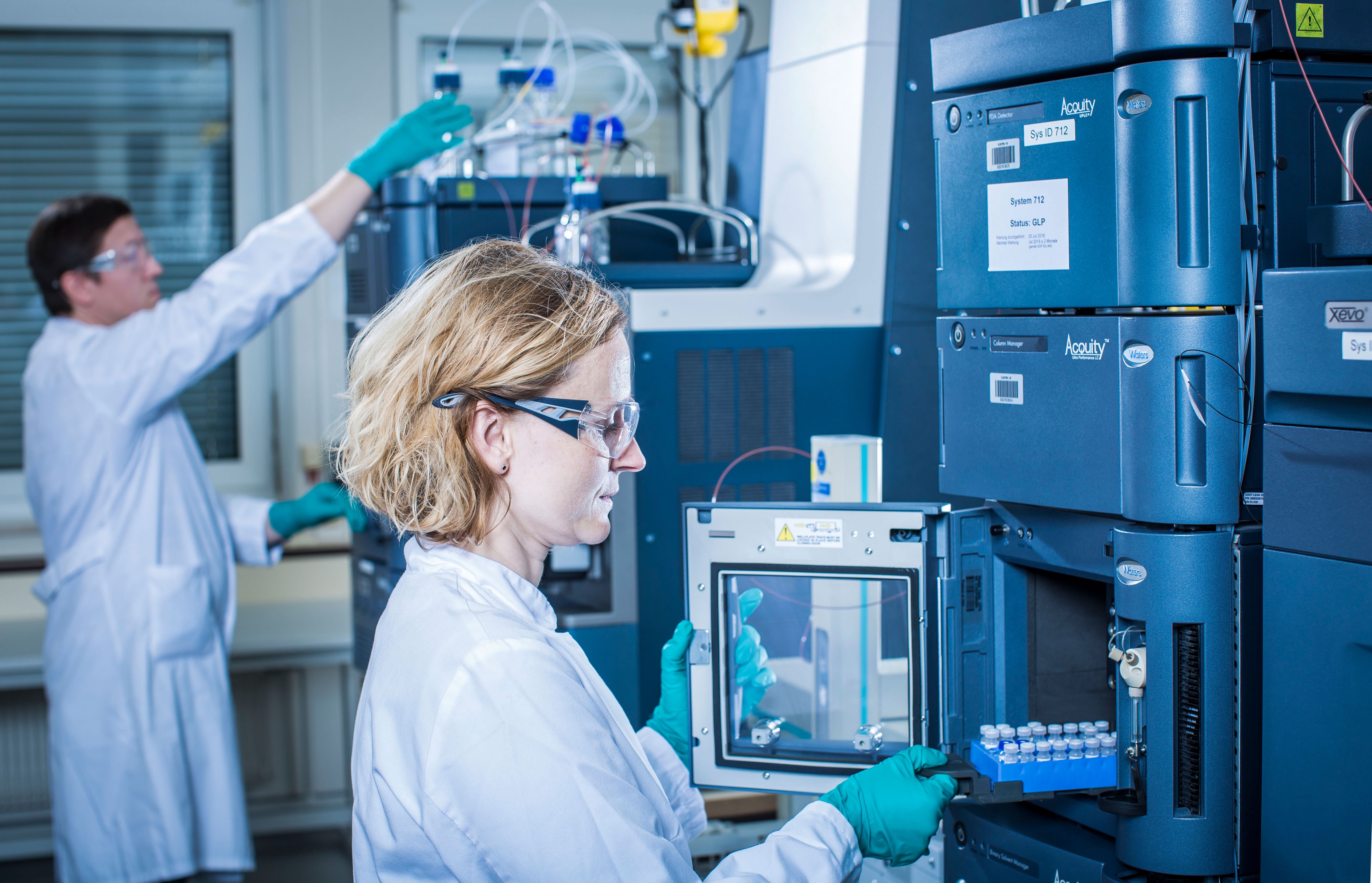

A scientist operates an HPLC machine, analyzing samples in a laboratory setting with precision and focus.

In vitro cross-species metabolism

The incubation of drug candidates with liver microsomes and/or hepatocyte suspensions from human and animal species aims to identify and quantify hepatic metabolites, enabling or confirming the selection of species for toxicological studies. Metabolite structure elucidation is supported by orthogonal parameters such as accurate mass and multi-stage mass (MSn) experiments. Our cross-species metabolism assay typically uses radiolabelled test compounds, with parent drugs and metabolites quantified by radioactive measurement via off-line scintillation counting. Using unlabelled test compounds is feasible but allows only semi-quantitative assessments based on mass-spectrometric responses. The assay can be supplemented by determining covalent binding of radiolabelled test compounds to hepatocyte or microsomal proteins, providing indications of reactive metabolite formation and assessing potential risks for idiosyncratic toxicity.

In vivo metabolite profiling and structure elucidation

This solution is available in virtually all matrices collected from preclinical species in pharmacokinetic and toxicokinetic studies as well as from humans in clinical trials, including human mass balance (hADME). We highly recommend investing in the identification of circulating human metabolites already within the first-in-human (FiH) trial. Quantitation of metabolites can be accomplished by either using reference standards (if available) or radiolabelled calibration samples generated with relevant in vitro test systems (e.g., hepatocytes) and applying high resolution mass spectrometry (HR-MS) combined with off-line radio detection. The evaluation of whether human metabolites are formed at sufficient levels by the toxicity species can be performed by analyzing matrix-matched plasma samples, even without requiring reference standards. The resulting relative metabolite exposures (human vs. preclinical species) will support the safety assessment of your drug candidate and help guide further development.

Contact us

Nuvisan is committed to protecting your privacy, and we'll only use your personal information to administer your account and to provide the products and services you requested from us. If you consent to us contacting you for this purpose, please tick below to say how you would like us to contact you:
You can unsubscribe from these communications at any time. For more information on how to unsubscribe, our privacy practices, and how we are committed to protecting and respecting your privacy, please review our Privacy Policy.

Talk to us

talk icon
+49 731 9840 0 

Our locations

location icon

Neu-Ulm (headquarters)

Wegenerstrasse 13

89231 Neu-Ulm

Germany

Berlin

Muellerstrasse 178

13353 Berlin

Germany

Sophia Antipolis

2400 route des Colles

06410 Biot

France

Grafing

Am Feld 32

85567 Grafing

Germany

Waltrop

Im Wirrigen 25

45731 Waltrop

Germany

For concerns about pharmaceuticals or adverse drug-related events, contact us at: complaints@nuvisan.com