
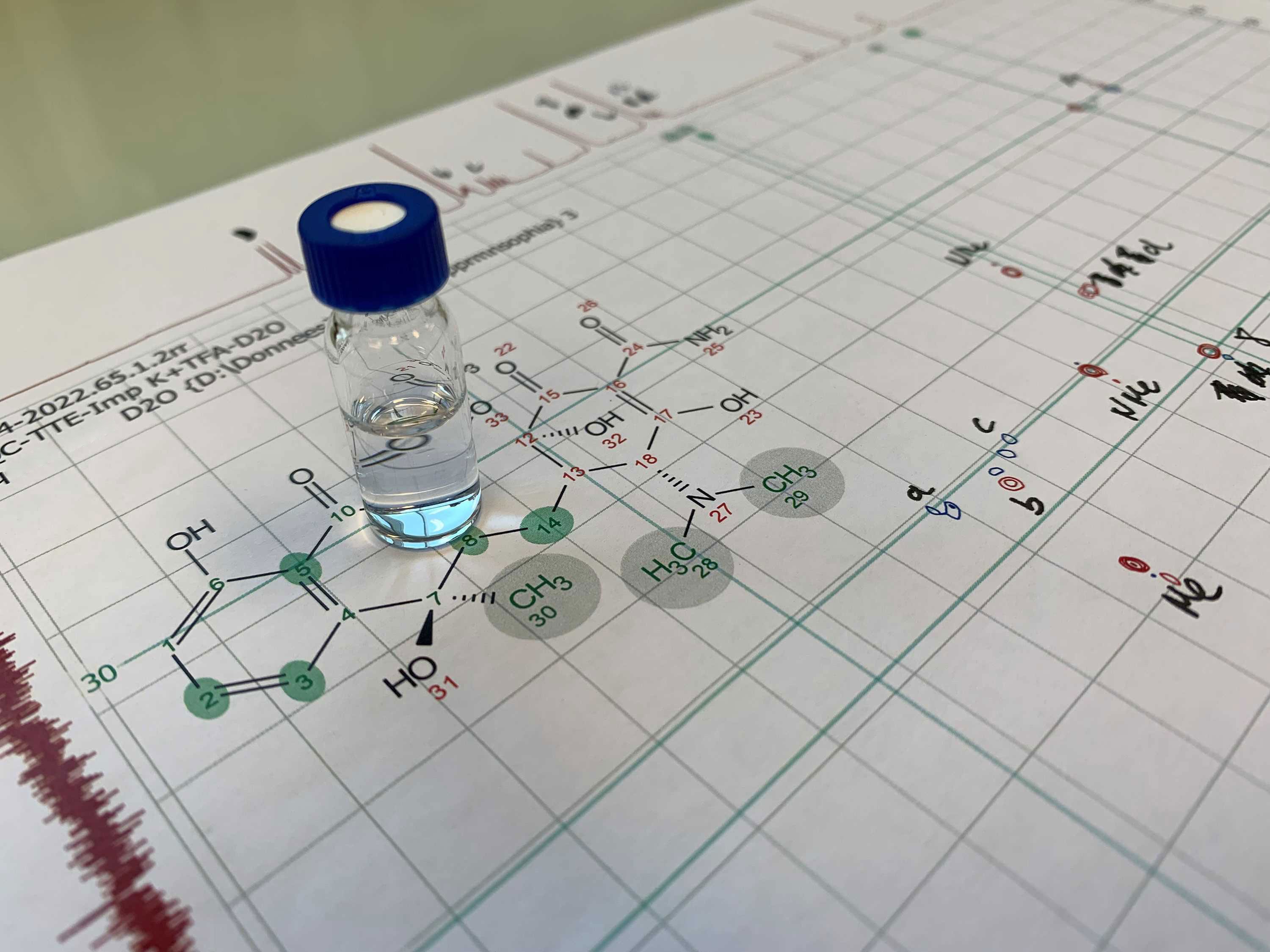
Case study: codeine impurity identification
A complete [1H], [13C] and [15N] assignment of an unknown codeine impurity
Case objective
The identification and structural elucidation of impurities is a routine requirement in process development according to the ICH Q3A(R2) and Q3B(R2) guidelines. Indeed, impurity identification is critical because impurities can affect drug safety, efficacy and quality. Identifying and controlling them helps ensure compliance with regulatory standards and protect patient health. In this case, an unknown impurity was found in a codeine drug product syrup during a yearly stability study. This raised safety concerns and required quick action to characterise the impurity and perform a toxicological assessment in order to exclude any patient risk.
Our approach and findings
High-resolution mass spectrometry (HRMS) investigations indicated an oxidation of codeine that had no instances of occurrence in known literature. Hydrogen peroxide oxidation of codeine was performed to enrich sample with the targeted impurity, submitted to preparative high-performance liquid chromatography (HPLC) and fully characterised by nuclear magnetic resonance (NMR) techniques. Position of oxidation and absolute configuration were determined using constant time inverse-detection gradient accordion rescaled heteronuclear multiple bond correlation (CIGAR-HMBC) spectroscopy at natural abundance.
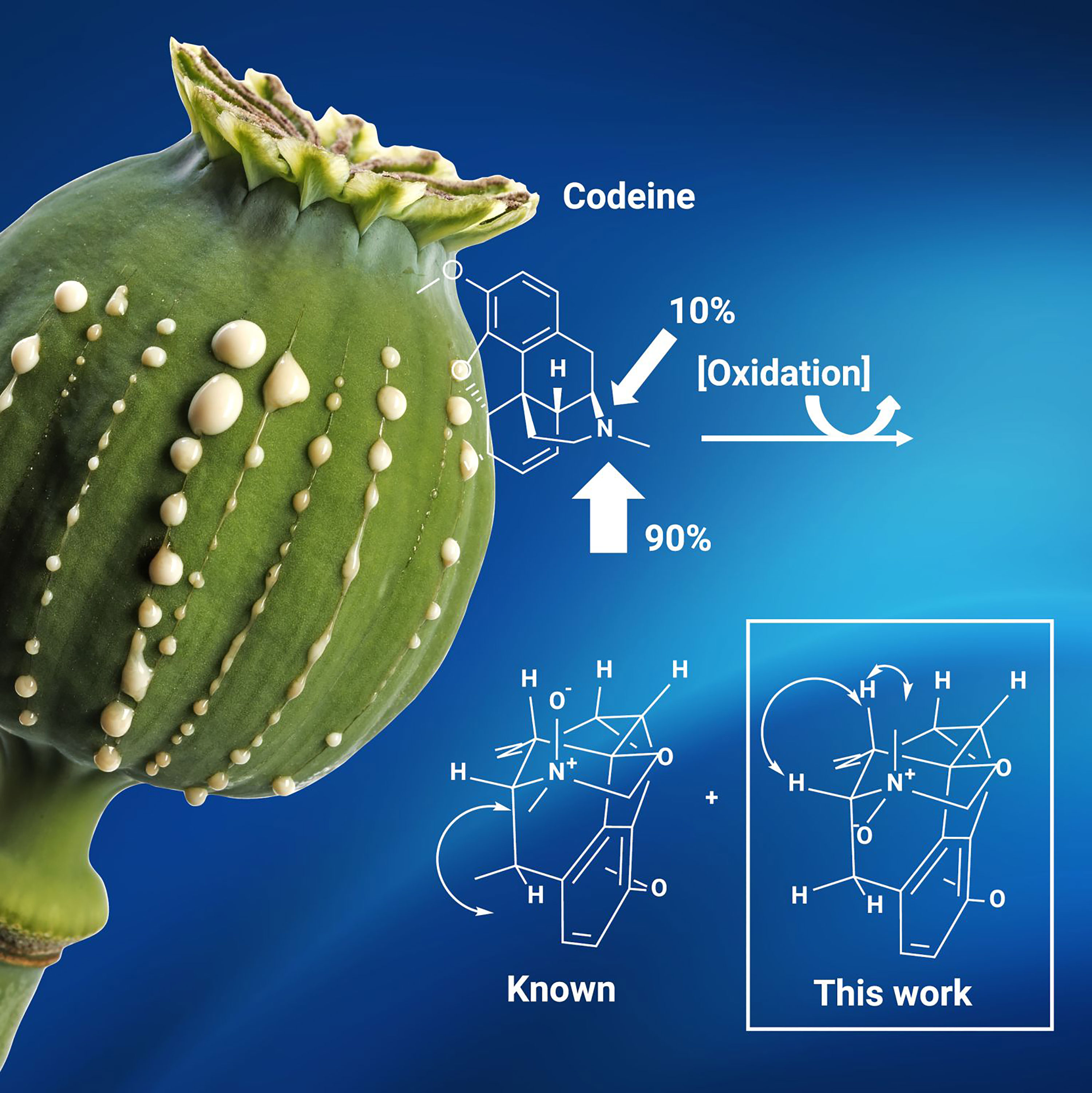
Elucidation of codeine and its (known and newly discovered) impurities
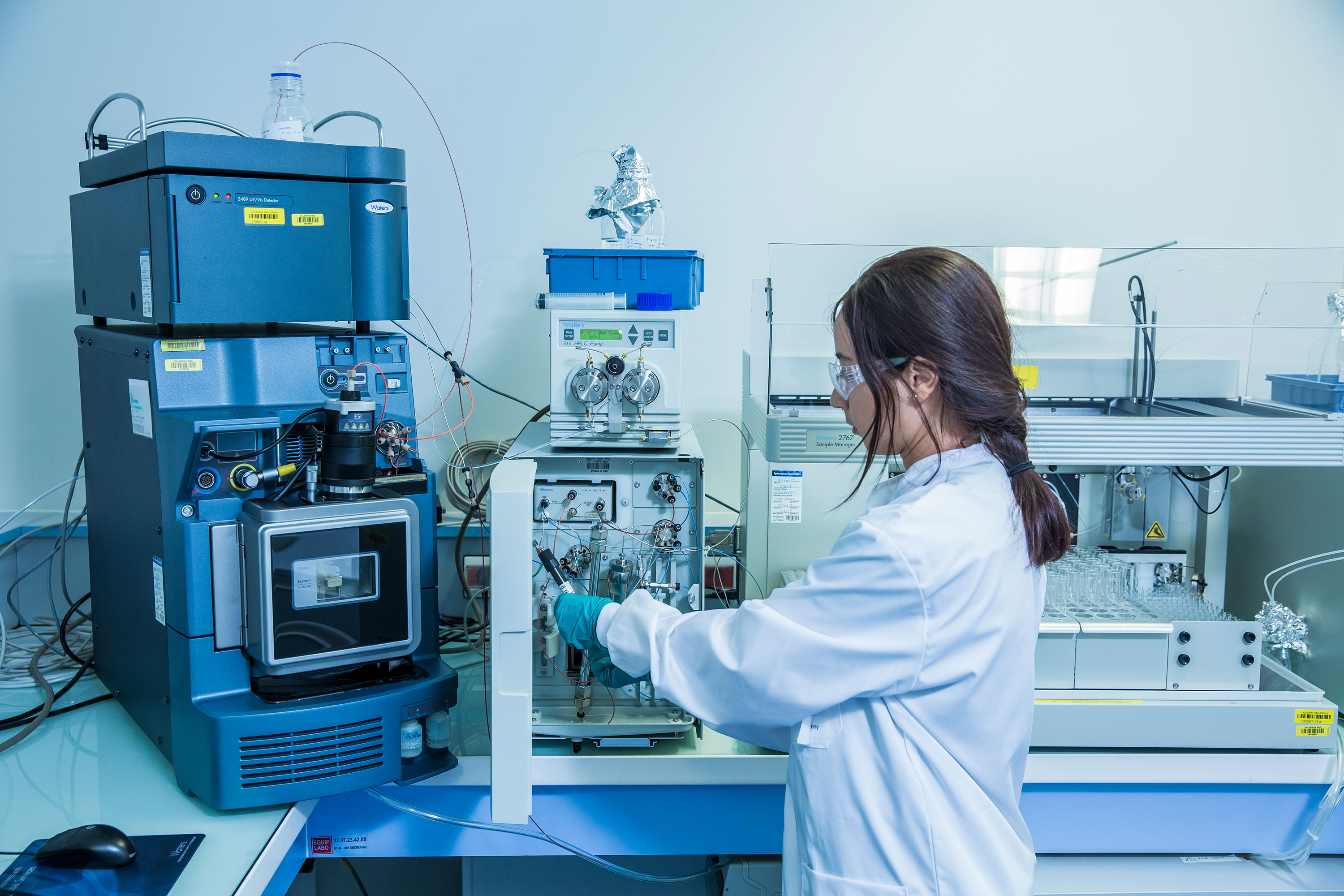
HRMS as an efficient and accurate impurity identification method
Conclusion and impact
We were able to comprehensively characterise the unknown impurity quickly, enabling Nuvisan´s toxicologist to conduct an in silico toxicological qualification and remove any safety concerns. This also led to a reassessment of impurities in the codeine drug product, which was then used to update the regulatory files.
Our case-specific key technologies
| Structural elucidation |
|
| Handling of controlled substances |
|
| Impurity isolation |
|
| Impurity synthesis |
|
| Characterisation |
|
Facing similar challenges? This is how Nuvisan´s chemical development experts can help to overcome impurity challenges
Our highly experienced scientists can isolate, identify, synthesise and assess unknown impurities present at very low levels (<0.1 %) at every stage of the drug development lifecycle. Our chemists can identify degradation pathways and potential ingredient interactions that will facilitate the examination of dossiers by regulatory agencies.
Our capabilities include:
- Development of a mass spectrometry (MS)-compatible method
- HRMS using Q-exactive equipment
- Fragmentation at different voltages of active pharmaceutical ingredients (API) and impurities and proposition of formula
- Chemical oxidation of codeine to enrich impurity content
- Isolation of impurity using preparative HPLC
- Structure elucidation using NMR techniques: [1H], [13C], correlation spectroscopy (COSY), heteronuclear single quantum coherence (HSQC), heteronuclear multiple bond correlation (HMBC), heteronuclear single quantum coherence (NOESY), CIGAR
- Synthesis of impurity on gram scale with full characterisation and certificate of analysis (CoA)
- Response factor measurement in the client analytical method.
CONTACT US
Source
Boiteau, J.-G. et al., Complete [1H], [13C] and [15N] assignments of the minor isomer of codeine N-oxide, Magn Reson Chem, 60, 12, 1185-1188 (2022).https://doi.org/10.1002/mrc.5302