
SAD/MAD/food-effect trial executed end-to-end, from first dose to peer-reviewed publication
A sponsor developing M5049 (enpatoran), a novel oral small-molecule dual antagonist of toll-like receptors 7 and 8 (TLR7/8), required a contract research organisation (CRO) to execute a complex first-in-human phase 1 study. Aberrant activation of the TLR7/8 pathway is implicated in autoimmune diseases such as systemic lupus erythematosus (SLE). M5049 with convenient oral administration represented a promising candidate for modulating this pathway.
The sponsor needed to evaluate the safety, tolerability, pharmacokinetics (PK) and pharmacodynamics (PD) of single and multiple ascending oral doses (SAD and MAD), as well as the effect of food (FE) on drug exposure — all within a single, efficient and adaptive study design.
Nuvisan delivered the entire program, bringing scientific rigour, regulatory alignment and end-to-end operational capability to meet the sponsor's objectives within a demanding development timeline.
This randomised double-blind clinical trial of M5049 used an innovative three-part, adaptive umbrella design.
Part A (SAD) evaluated seven escalating single doses of M5049 (1–200 mg) or placebo using a sentinel dosing strategy.
Part B (MAD) was initiated after Safety Monitoring Committee (SMC) review of cumulative safety, tolerability, PK and PD data of the first SAD cohorts. Participants received five dose regimens of M5049 (9–200 mg once or twice daily) or placebo for 14 days.
Part C assessed the food effect (FE) in one cohort of part A with participants receiving a second single dose under fed conditions.
Safety and tolerability evaluations included physical and neurological exams, vital signs, ECGs, early PK–ΔQTc modelling, laboratory tests and cytokine monitoring.
As the TLR7/8 pathway is not active in normal tissues, pharmacodynamics were assessed ex vivo using the TLR7/8 agonist resiquimod (R848) in TruCulture® whole blood assays, measuring IL-6 and IFNα to evaluate target engagement and explore PK/PD relationships.
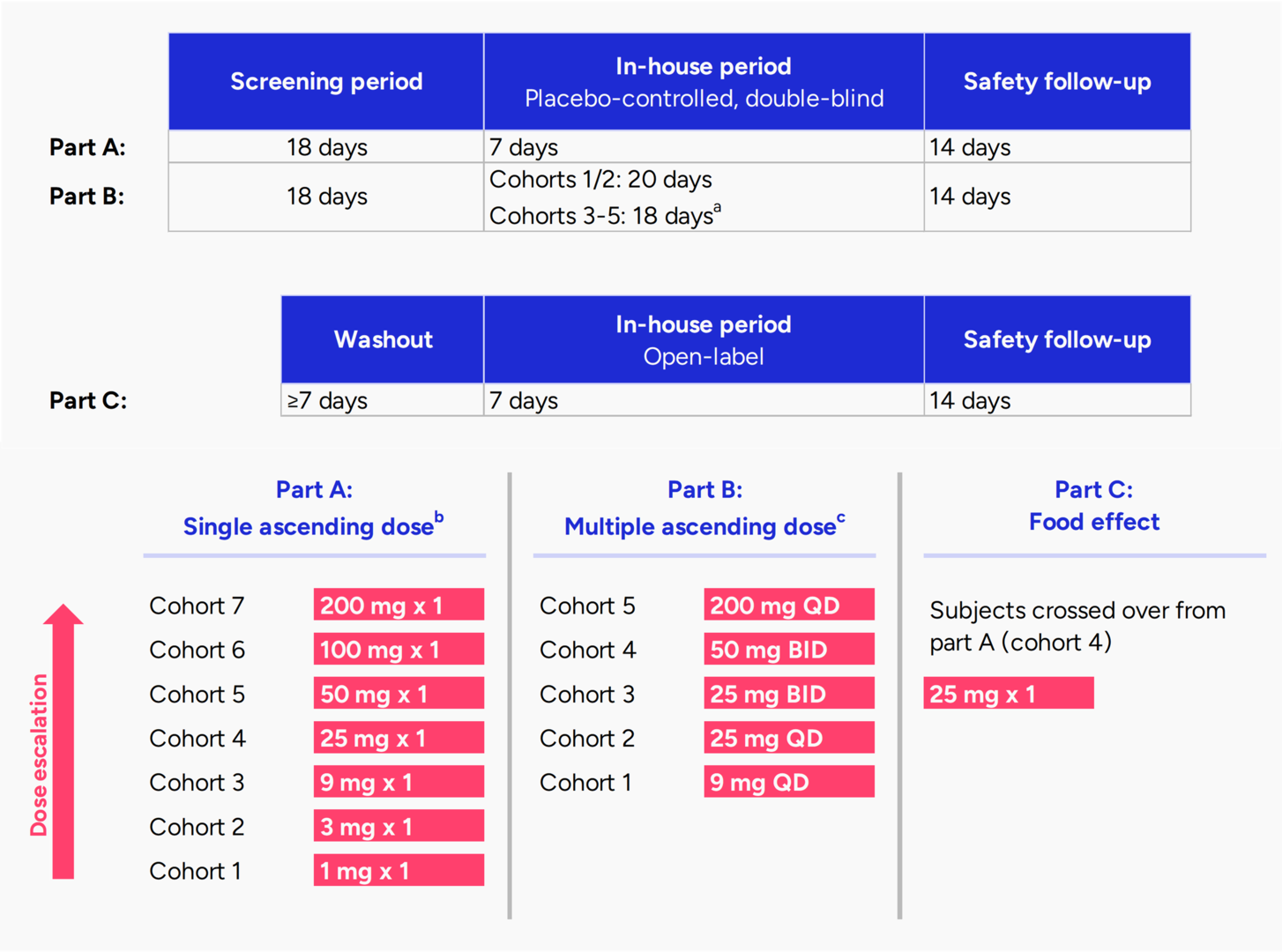
Study design and dose escalation scheme. Eight participants were randomised to each cohort, six to active treatment and two to placebo. Eight participants in part A, cohort 4, crossed over to part C. a The primary observation period was reduced to 17 days for cohorts 3–5 of part B, since available clinical data showed this timeframe provided sufficient safety, tolerability and PK monitoring; b Single‐dose cohort escalation (part A): decision based on safety data from a single dose plus 1 week in‐house; c Multiple‐dose cohort escalation (part B): decision based on safety data from 2 weeks of treatment until the end of the in‐house period. BID, twice daily; QD, once daily.
An adaptive, risk-managed dose escalation strategy
The trial protocol predefined initial dose levels and applied a dynamic algorithm integrating real time safety and PK data. In addition to standard safety measures, intensive PD assessments were included to better characterise drug activity.
A Safety Monitoring Committee was empowered to adjust doses within a predefined framework without requiring substantial protocol amendments. This adaptive approach was pre-approved by the Competent Authority and the Ethics Committee, who received regular updates on escalation decisions.
Recruitment followed planned timelines. To maintain momentum, participants for subsequent dosing cohorts were recruited while safety reviews of prior cohorts were ongoing.
Moreover, PK samples were analysed on site enabling short intervals between cohorts.
The study was completed on time and within budget while all 96 randomised participants (female and male) completed the trial without dropout. The transition from SAD to MAD dosing was approved without the need for substantial protocol amendments, keeping the program on track. A small number of amendments were required following emerging preclinical safety and pharmaceutical data, but our clinical experts implemented them swiftly and without jeopardising the timeline.
Nuvisan’s integrated clinical services team eliminated coordination risk and supported a seamless execution by providing comprehensive clinical trial services, including:
The study results were subsequently published in a peer-reviewed journal, providing the sponsor with an additional layer of scientific credibility.
This case demonstrates how adaptive design, regulatory oversight and integrated full-service delivery can streamline complex early-phase studies while maintaining high quality standards.
With over 40 years of clinical trial experience and more than 390 trials conducted since 2000, Nuvisan delivers comprehensive, end-to-end phase 1 and 2 services from our Clinical Pharmacology Unit in Neu-Ulm, Germany.
Ready to discuss your early-phase program? Contact our clinical experts at hello@nuvisan.com to discuss how we can help.
Port A. et al., Phase 1 study in healthy participants of the safety, pharmacokinetics and pharmacodynamics of enpatoran (M5049), a dual antagonist of toll-like receptors 7 and 8. Pharmacol Res Perspect (2021) Oct;9(5):e00842.https://doi.org/10.1002/prp2.842

Discover how our comprehensive clinical trial services can support your program.
Learn more
Explore Nuvisan’s solutions for simple to complex early phase clinical trials.
Learn more
Watch the video of Nuvisan’s Clinical Pharmacology Unit in Neu-Ulm, Germany.
Learn more































 Contact Us
 Search