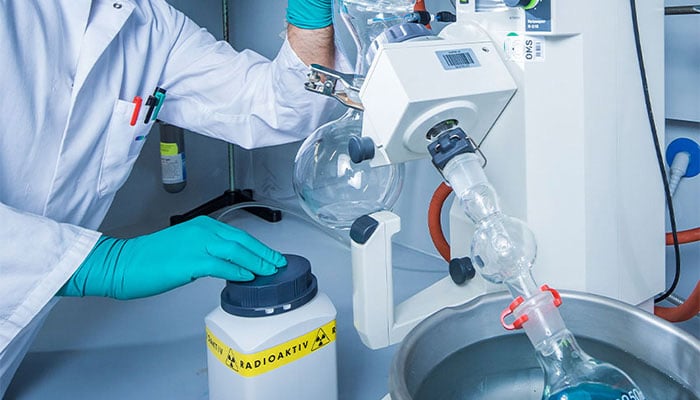
AME (mass balance, metabolite profiling and identification)
Radiolabelled absorption, metabolism and excretion (AME) studies in rodent and non-rodent species are crucial for non-clinical drug development, assessing the disposition of unchanged drugs and total drug-related material. These data are vital for safety and efficacy assessments and regulatory submissions, aiming to determine the radioactive dose excreted in urine, faeces, and expired air (mass balance). Both animal mass balance and QWBA data inform dosimetry calculations for safe radioactive doses in human mass balance (hADME) studies.
We have many years of experience in conducting mass balance studies in rodent and non-rodent species, adhering to the 3R principle (replace, reduce, refine) to deliver maximum information with cost-effective designs. Radioactivity is quantified by liquid scintillation counting (LSC) in blood, plasma, urine, faeces, bile and, if needed, expired air, various tissues, and carcasses. Our biotransformation team generates metabolite profiles in all matrices using off-line scintillation counting after chromatographic (UPLC) separation and fraction collection, allowing quantification of low-level radioactive signals. Metabolite structures are elucidated by high-resolution mass spectrometry (HR-MS) according to predefined quantitative thresholds relative to the radioactive dose.